Thinking about how to travel to Moscow in 2026? Whether it’s your first time in Russia or you’re a seasoned traveler like me, this first-hand travel guide to Moscow will show you exactly how to make the most of your trip to one of the most intriguing and layered capitals in the world.
I first visited Moscow when I was just 15, on a school trip with my Russian teacher, Irina. To say the least, I was impressed. That trip left a mark, and more than a decade later, I still go back almost every year to visit a born-and-bred Muscovite friend who helps me explore the city through a local lens.
Moscow, Russia’s largest city in both size and population, is an ever-evolving beast: a mix of modern skyscrapers, Slavic soul, and Soviet grandeur. It’s clean, safe, fast-paced, and always surprising. Honestly, I even prefer it to Saint Petersburg.
This up-to-date travel guide to Moscow in 2026 is based on years of visits and is loaded with practical tips, honest insights, and off-the-beaten-path suggestions to help you experience the city the way locals do.
Last updated 3 June 2026

Why travel to Moscow in 2026?
Go before everyone returns. Simple as that. Before 2022 you’d see and hear lots of foreigners including westerners on the Red Square, now it’s mostly tourists from the Gulf countries and east Asia.
Don’t get me wrong. Tourists have not deserted the country completely but they are much more scarce than before. When peace will be back (hopefully soon for everyone), tourists will flunk back to Moscow just like nothing never happened. Seize your chance and go before everyone returns.
3 reasons to visit Moscow now:
• Culture meets modernity: rich past, old Soviet buildings and grand monuments now coexist with skyscrapers and trendy cafés.
• Affordable: Due to recent economic changes, Moscow is more affordable for travelers, especially for westerners, the currency exchange is advantagous.
• Must-see landmarks: From the famous Red Square with the Kremlin, to Soviet relics and world class museums, Moscow has it all.
 Nikolskaya street
 Nikolskaya street
Is it safe to travel to Moscow in 2026?
Yes, Moscow is very safe for tourists and locals alike. The level of tourist-related crime is very low and most of the major tourist areas are well-monitored by police and security services.
That might surprise you, especially if your only reference is Western media, but anyone who’s traveled to Moscow (or Russia in general) will tell you the same: you feel at ease there.
• Security is visible, and normal
Metal detectors, scanners, and uniformed guards are everywhere: metro stations, malls, train stations, museums. It might feel intense at first, but it’s standard and helps keep things safe.
• Pickpocketing? Possible, but rare
Petty theft exists like anywhere, but much less than in cities like Paris or Barcelona. You won’t need to wear your bag on your chest. It’s perfectly normal to take out your expensive phone or camera in public, nobody’s going to snatch it from you like in London.
• Locals don’t act paranoid, and neither should you
Muscovites walk around with their phones in hand or in the backpocket of their jeans, headphones on, even at night. That speaks volumes.
• Pedestrian crossings are underground
Crossing Moscow’s multi-lane roads usually means heading underground. Some of these tunnels are huge and can feel like mini-metro systems. Since the 2018 World Cup, most touristy areas have English signage, but pay attention to your exit, or you may pop up on the wrong side and have to backtrack.
• What about the police?
Contrary to some clichés, Russian police in the capital are generally helpful and professional, not corrupt or intimidating. If you need directions or help, just ask.
 Red October factory (Prechistenskaya embankment)
 Red October factory (Prechistenskaya embankment)
How to travel to Moscow in 2026: Visas, flights & entry requirements
Before you pack your bags for Moscow, make sure you understand Russia’s current entry requirements, including visa rules, flight routes, and basic travel formalities.
Do you need a visa to visit Russia in 2026?
In most cases, yes, you’ll need a tourist visa to enter Russia. But the process isn’t as hard as it used to be.
• Option 1: Standard tourist visa (1-3 months)
This is the classic Russian visa, issued at your local consulate. To apply, you’ll need:
– A valid passport (with at least 6 months’ validity)
– A Letter of Invitation (LOI), also known as Voucher. I recommend the one from GoingRus : cheap and reliable.
– A mandatory travel insurance. I recommend Attollo Assistance : reliable and meets 100% of Russian consular requirements
📌 Read my visa guide for all details & tips
• Option 2: eVisa (16 days max)
Citizens from certain countries (like Europeans) can now enter Russia with a simple eVisa, valid for up to 16 days:
– Easy to apply online
– Much cheaper than the full visa (~50€)
– Approved within a few days
📌 Check out my step-by-step eVisa guide for all details
• Travel insurance tip: It’s mandatory for all types of visas, regular touritst visa and eVisa included. I recommend Attollo Assistance : cheap, reliable, you can buy the policy with your foreign Visa/Mastercard and it meets all of Russian consular requirements.
How to travel to Moscow overland: via the Baltics
If you’re looking for the cheapest way to travel to Moscow from Europe, your best option is going overland via the Baltics.
• Route 1: Via Saint Petersburg
Take an international bus from Riga, Vilnius, or Tallinn to Saint Petersburg, then continue to Moscow by train.
– Overnight sleeper: Save on accommodation and arrive in Moscow ready to explore
– High-speed Sapsan: Just 4 hours from Saint Petersburg to Moscow
📌 Check out my Narva-Ivangorod border crossing post for all details
• Route 2: Via Pskov
An alternative option is traveling via Pskov.
– Buses run from Riga or Tallinn to Pskov
– From there, take an overnight train to Moscow.
📌 Check out my Luhamaa-Shumilkino border crossing post for all details
• Booking tips:
– For buses, book directly with LuxExpress (my favorite) or Ecolines official websites
– For trains, use RussianTrain : English interface, Visa/Mastercard accepted
 Narva-Ivangorod border
How to fly to Moscow in 2026
Moscow is well connected to the rest of the world, but due to ongoing sanctions, there are no direct flights from the EU, UK, or USA.
Instead, most travelers reach Moscow via a layover in neutral countries.
• Best flight routes to Moscow from Europe:
– Turkish Airlines (via Istanbul)
– Serbia Airlines (via Belgrade)
• Alternative routes :
– Emirates (via Dubai)
– Qatar Airways (via Doha)
– Azerbaijan Airlines (via Baku)
Due to sanctions, European based booking platforms no longer sell flights to and around Russia. I recommend Aviasales (the .com version, not .ru), which redirects to international flight booking agencies such as Turkey-based Unfly and UAE-based City Travel or Onetwotrip. At the time of update (June 2026), these platforms accept foreign Visa and Mastercard payments.

Getting from Moscow airports to the city center
• Moscow has three international airports: Sheremetyevo (SVO), Domodedovo (DME), Vnukovo (VKO)
The easiest, most stress-free way to reach the city center from any of them is to take the Aeroexpress train – fast, reliable, and avoids all traffic.
– From Sheremetyevo to Belorussky station ~35 min, 650₽ one way
– From Domodedovo to Paveletsky station ~45 min, 650₽ one way
– From Vnukovo to Kievsky station ~35 min, 500₽ one way
Trains run every 10 to 60 minutes. All train stations connect directly to Moscow’s Metro.
• What about taxis?
Use Yandex Go (Russia’s Uber equivalent) : safe, affordable, and you can pay cash to the driver.
 Viewing platform at the Zaryadye park
 Viewing platform at the Zaryadye park
How to get around Moscow: Metro, taxi & transport tips
Getting around Moscow is easy, thanks to its reliable and budget-friendly public transportation options. The Moscow Metro, in particular, is world-class: clean, safe, and a sightseeing experience in itself.
• Moscow Metro: Efficient, beautiful, and quite cheap
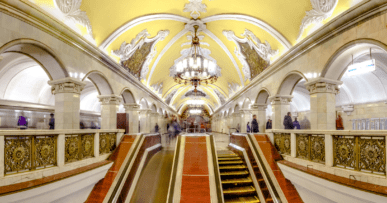
With over 270 stations, many of which look like underground museums, the Moscow Metro is the fastest and most iconic way to move around the city.
– Get a Troika card at any station – it works on the metro, buses and trams.
– Rides cost 63₽ (Troika fare)
– Local tip: Listen to the voice! A male voice means you’re heading toward the city center, and a female voice means you’re moving away from it.
– Most signs are translated into English since the 2018 World Cup.
– Exit carefully: Some stations have huge underground passages. At major landmarks like the Red Square, take the correct exit or you might pop up quite far away from the Kremlin.
• Tram & bus: Scenic and great for short distances
Moscow’s tram network is less extensive but still useful in certain areas. You can combine with buses. It’s a scenic way to explore outer neighborhoods or older districts at a slower pace.
– Troika card works here too but you can also pay cash.
– Trams and buses are clean (less so in winter obviously) and generally on time, but slower than the metro.
• Taxis & Yandex Go: Cheap, safe, and App-based
Use Yandex Go, Russia’s version of Uber. It’s reliable and inexpensive compare to western taxi fares.
– You don’t need a Russian bank card, you can pay in cash to the driver.
– Avoid street taxis, stick to the App for fair prices and safety.
Bonus tip: Got a Russian bank card?
You can skip the Troika card altogether, just tap your contactless Russian bank card (Mir payment system) directly at the metro, tram, or bus validator (the same machine used for transport cards). It’s just as fast and charged at the same rate.
 Okhotny Ryad station
 Komsomolskaya station
 Novokuznetskaya station
- Okhotny Ryad station
- Komsomolskaya station
- Novokuznetskaya station
Where to stay in Moscow in 2026: Best areas & accommodation tips
Moscow is massive, a true megacity of contrasts, where imperial grandeur meets brutalist concrete, and where you can go from cobbled alleys to Stalinist skyscrapers in a single metro ride. Picking the right area to stay isn’t just about budget or location – it shapes your whole experience of the city.
If you’re a first-time traveler, you’ll want to stay somewhere central: Kitai-Gorod (Moscow’s old “Chinatown”) with its pebblestone streets and golden cupolas; elegant Tverskoy near Red Square and the Bolshoi; or hip corners like Zamoskvorechye and Patriarch’s Ponds, where locals sip wine and life feels surprisingly European.
Further out, districts like VDNKh area and Sokolniki offer space, calm, and greenery – and let you glimpse local life beyond the tourist grid. These areas are often more affordable and full of charm in their own way, but be warned: if you’re based too far from the center, commuting can eat up your time (easily an hour each way in this sprawling capital).
So where should you stay? Here’s my handpicked districts list, plus booking tips and registration advice.
TL;DR – Best areas to stay in Moscow
• Kitai-Gorod → Iconic sights, cobbled charm | Walkable, historic | Perfect for sightseeing
• Arbat → Restaurants, souvenirs | Lively but touristy | Personally not my top pick
• Tverskoy → Landmarks, shopping, nightlife | Central & well-connected | Great for first-timers
• Patriarch’s Ponds → Stylish brunch spots, wine bars | Trendy & upscale | Chic, pricey
• Zamoskvorechye → Local feel, old churches, quiet cafés | Authentic & underrated | One of my favorites
• Ostankino → VDNKh, space museum, green parks | Family-friendly & spacious | Fun but a bit far from the very center
All hotels and hostels can be booked (and fully paid) on Ostrovok.
Kitai-Gorod: Historic Moscow
Staying in Kitai Gorod puts you in the heart of Moscow’s historic center. You’ll be steps from the Kremlin, St. Basil’s Cathedral and the iconic GUM shopping mall, ideal for first-time visitors who want to be in the middle of everything.
Just east of the Red Square, you will find cobbled alleys, merchant courtyards, and golden-domed churches tucked between trendy cafés.
Wander down Myasnitskaya street, explore the quiet lanes near Staraya Ploshchad, and detour into charming streets like Nikolskaya, Ilyinka, and Varvarka, where you’ll find some of Moscow’s oldest churches. Zaryadye park also starts here, offering panoramic skyline views right beside the Kremlin.
🟢 Pros: Iconic landmarks, walkable charm, rich history.
🔴 Cons: Can feel touristy around the main squares.
 Myasnitskaya street
Arbat: Moscow’s famous pedestrian street
Arbat is one of Moscow’s oldest and most iconic streets, now fully pedestrian and lined with souvenir shops, street art, galleries, and restaurants. Once home to poets and intellectuals, today it’s a buzzing corridor of tourism. Located just west of the Kremlin, it’s also a practical area to stay in the city center.
Note: There are actually two Arbat streets (and two metro stations, which can be confusing). Stary Arbat (Old Arbat) offers a blend of historic charm and tourist kitsch, while Novy Arbat is its broader, louder, more Soviet-style cousin.
🟢 Pros: Central, walkable, lively, packed with shops and restaurants.
🔴 Cons: Honestly, too touristy for my taste.
Tverskoy: Moscow’s central hub
Just north of the Red Square, Tverskoy is one of Moscow’s most convenient and stylish districts. It’s home to Tverskay Street, kind of Moscow’s answer to the Champs-Élysées, along with the Bolshoi Theatre, upscale shopping and dining scene. This is a great base if you want to be close to the Kremlin and well, connected by metro. Tverskoy is also home to Kitai-Gorod talked previously.
🟢 Pros: Central and close to major landmarks and theaters.
🔴 Cons: Can be pricey, especially along main streets.
 Tretyakovsky Passage
Patriarch’s Ponds: The fancy Moscow
Trendy with high-end vibes, Patriarch’s Ponds is where Moscow’s stylish crowd hangs out. Think upscale restaurants, and cocktail bars in the city center. If you like boutique hotels, brunches, and a bit of people-watching, this is your spot. More on that area bellow.
🟢 Pros: Chic, full of atmosphere, great for nightlife.
🔴 Cons: One of the pricier parts of the city.
Zamoskvorechye: Hidden gems & quiet charm
Just across the Moskva River from the Red Square, Zamoskvorechye offers a quieter, more local slice of Moscow, all within walking distance of the center. Expect cobbled lanes, old merchant mansions, colorful churches, and cozy cafés tucked between leafy courtyards. Pyatnitskaya street is the district’s spine, lined with restaurants and bars, but wander into side streets like Klimentovsky lane (Pereulok) for a more peaceful stroll.
This area is also home to some standout museums:
• Tretyakov Gallery (Old building), a must for Russian art lovers.
• Bakhrushin Theatre Museum, a gem for performing arts buffs.
• Ice Sculpture Gallery (it’s seasonal, obviously), surprisingly fun if you stumble on it.
🟢 Pros: Calm, historic, authentic vibe with great dining.
🔴 Cons: Fewer hotels, limited metro lines nearby.
 Pyatnitskaya street
Ostankino: Space, science & green escapes
Ostankino, just north of central Moscow, feels like stepping into another world. It’s home to the vast VDNKh expo park, the iconic Museum of Cosmonautics, and the towering Ostankino TV Tower, where you can catch panoramic city views.
This is a great spot for families, space lovers, or longer-term travelers looking for something beyond the tourist core. You’ll also find the Main Botanical Garden, one of the largest in Europe.
Hidden tip: Walk down Academician Korolev street for retro Soviet vibes, and don’t miss the Ostankino Palace, a beautiful and often-overlooked wooden mansion from the 18th century.
🟢 Pros: Educational attractions, relaxed vibe, lots of green space.
🔴 Cons: A bit far from the very center; more residential and less walkable for sightseeing.
 VDNKH park
Hotel registration in Russia: It’s confusing (even for me)
If you’re traveling to Russia in 2026, here’s what you need to know about mandatory hotel registration for foreigners:
• The Rule: By Russian law, all foreign visitors must be registered with local migration authorities if they’re staying more than 7 business days in the same city. This rule applies whether you’re in Moscow, Saint Petersburg, or elsewhere in Russia.
• Staying in a hotel or hostel? Good news, the hotel should handle the registration for you at check-in. They’ll scan your passport, visa, and migration card, then file the paperwork on your behalf. Many hotels will register you even if you stay one night and some hostels definitely won’t bother to do it even if you ask.
✔️ Registration is free – they should not ask you to pay for it.
✔️ You should receive a registration slip (usually in Russian) within a few hours or by the next day.
✔️ Double-check for mistakes if you can: especially your names or country of origin.
Note : Some budget hotels or religious guesthouses for instance, might skip it. Some don’t even know how to proceed – but technically it’s still their legal responsibility.
• Staying in an short term rental apartment? You’re still legally required to register, but hosts are unlikely do it. In that case, you’ll need to use a registration service – some travel agencies or even nearby hotels can provide this (for a fee).
• Reality check: In years of traveling around Russia, I’ve never ever been asked to show my registration slips, not at airports, train stations, when exiting the country at borders or even during random encounters with the FSB.
 Tsaritsyno Palace
 Tsaritsyno Palace
I share the behind the scenes of my travels (real-time stories, messy bits etc) on Telegram

What to eat in Moscow: Local food, cafés & restaurants
Moscow’s food scene in 2026 is more exciting than you might expect: a flavorful mix of traditional Russian dishes, post-Soviet culinary influences, modern cafés, and budget-friendly canteens. Whether you’re craving Siberian dumplings, classic Slavic beetroot soup, seafood from the Russian Arctic, surprisingly good Caucasian wine, or a RAF coffee (sweet Russia-invented coffee), you’ll eat and drink well in the Russian capital.
Russian food & drink places: A quick lexicon
From stolovaya to kofeynya, ryumochnaya, and Russian-style kafés, I break down the essential types of food and drink spots you may come across in Moscow, and why each one is worth a visit. Here’s your quick guide to the most common local eateries, their Russian names, and what to expect.
| Term | Meaning |
|---|---|
| Kafé (кафе) | Don’t be misled by the name. In Russia, a café (кафе) isn’t a trendy coffee shop serving lattes, it’s more like a basic, no-frills restaurant. It’s typically a casual, budget-friendly eatery offering simple russian meals. A quick, affordable dining with minimal service. |
| Restauran (ресторан) | As the name suggests, a restaurant in Russia is a full-service dining establishment, just like those found worldwide. It typically offers table service and an extensive menu. Expect attentive service (manage your expectations, sometimes it’s sh*t anyway) and thoughtfully prepared dishes. Traveling with kids? Russia is a very family-friendly country, and most restaurants offer a dedicated kids’ menu (детское меню). |
| Stolovaya (столовая) | Soviet-style self-service cafeteria. Cheap and fast, always the same Russian classics like soups, salads, buckwheat, and cutlets. Expect functional décor, nothing fancy but some places actually look super nice. |
| Kofeynya (кофейня) | A coffe-shop, with baristas and espresso-based drinks. Great for trying a Russian RAF coffee (invented in the 90’s – sweet latte with cream and vanilla sugar). They also often serve sandwiches and freshly baked pastries. |
| Ryumochnaya (рюмочная) | Originally, a ryumochnaya (from ryumka, meaning “shot glass” – kind of) was a small, standing-only Soviet shot bar. These no-frills establishments served quick shots of vodka or strong spirits, sometimes alongside basic snacks like pickles, herring, or chebureks. No seats, just tall counters, drink and go. Today, ryumochnayas haven’t completely vanished. Some survive as nostalgic watering holes, while others have been reimagined as hipster-friendly spots serving infused vodkas, craft spirits, and even full meals. Whether grimy or fancier, ryumochnayas are a cultural curiosity worth checking out. |
| Food court (фуд-корт) | Over the past decade food courts got incredibly popular. Found inside major shopping malls as well as historic covered markets such as Danilovsky Rynok just to name one. You’ll find everything from Vietnamese pho (a Russian favorite) to Uzbek plov, Dagestani chudu and Georgian khinkali. One place I really recommend is the Home of Russian Cuisine at VDNKh, a curated food hall dedicated to showcasing Russia’s rich regional gastronomy. Here, you can literally eat your way across 15 regions of Russia, from Petropavlovsk-Kamchatsky to Kaliningrad. Regional specialties include dishes from Karelia, Chechnya, Altai, Udmurtia, and Yakutia, making it the perfect stop if you’re eager to explore the diversity – and occasional weirdness (try the yakutian indigirka salad if you dare) – of Russian cuisine all in one place. |
Food Hack: Eat at orthodox refectories Instead of Stolovayas
Instead of going to a regular Stolovaya, try a religious canteen/refectory – called Trapeznaya (трапезная). These hidden gems are usually tucked inside or next to Orthodox monasteries and churches, and yes, they’re open to the public, not just to monks.
What makes them special? Trapeznayas offer cheap, homemade meals. The food follows the Orthodox religious calendar, meaning the menu changes based on fasting periods and feast days. Expect a religious atmosphere, eating surrounded by frescoes and religious icons.
 Trapeznaya at the Vysoko-Petrovsky monastery
Must-try Russian dishes in Moscow
Moscow is heaven for curious eaters. Start with the iconic pelmeni, Russian dumplings usually stuffed with minced meat – served either in broth or topped with smetana (sour cream). Don’t mix them up with vareniki, their vegetarian (or sweet) cousins filled with potato, cabbage, cherry, or tvorog (curd cheese). If you spot kundyumy on a menu, order them, these rare mushroom-filled baked dumplings (I’ve only seen them twice in a decade of travel) are delicious treasure from old Russian cuisine.
Savor a bowl of borsch (beetroot soup) with borodinski rye bread or try the tangy solyanka, a rich, meaty soup with lemon and pickles. For a hot snack on the go, grab a crispy cheburek – a deep-fried Crimean Tatar pastry stuffed with meat or cheese.
For breakfast or comfort food, go for kasha, warm porridge made from grains like oats, rice, or semolina, often sweetened and served with jam, if available try the Guryevskaya kasha. The hearty grechka (buckwheat) is Russia’s humble grain staple, served alongside stews, mushrooms, or just with butter. You’ll also see pirogi everywhere, savory or sweet baked buns filled with meat, cabbage, mushrooms, or berries – perfect for a quick bite.
And don’t miss koulibiac, layered pastry pie filled with salmon, rice, eggs, and dill. It’s the Russian answer to Beef Wellington and a centerpiece at holidays or upscale restaurants.
You’ll also come across chicken Kiev, a Ukrainian-Russian dish of crispy breaded chicken stuffed with garlic-herb butter. Think of it as a Slavic take on French cordon bleu, and yes, it oozes.
Need a sugar fix? Try syrniki, golden-fried cottage cheese pancakes with jam and smetana or classic blinis with condensed milk. For something quirky, brave the jiggly kholodets (meat jelly), or sample the wildly colorful herring under a fur coat, a beet-mayo-layered salad that’s surprisingly delicious. Don’t forget olivier salad (a hearty Russian potato salad despite its French name) or vinaigrette, a beet-and-pickle-based Soviet-era classic. Finish your meal with a Napoleon cake for dessert.
Still thirsty? Warm up with a zesty mug of oblepikha tea (sea buckthorn) or wash it all down with Russian berry mors, or some Krasnodar wine.
Of course, if you want a cliché Russian meal you can always go for the combo blinis-red caviar-vodka.
 Pelmeni + smetana
 Salo, vinaigrette salad, blini, borodinski bread, borsch etc
 Sea buckthorn tea
 Russian salads
 Pirogi
 Syrniki
- Pelmeni + smetana
- Salo, vinaigrette salad, blini, borodinski bread, borsch etc
- Sea buckthorn tea
- Russian salads
- Pirogi
- Syrniki
Didn’t book hotel breakfast? Read this before you go hungry
If you skipped breakfast at your hotel thinking you’d grab something on the go, think again. In Russia, even in big cities like Moscow, many coffee shops and restaurants don’t open until 9:30 or 10AM. Yep.
If you’re up early and hoping for a proper breakfast, you might struggle to find something open. But don’t worry, you’ve got options.
• Prep the night before: If your hotel or guesthouse doesn’t offer breakfast, consider picking up some supplies the night before. Most rooms have a kettle, cups, and a fridge, or even a shared kitchen in guesthouses and hostels.
• Early-opening spots: Some coffee shops and bakeries do open early, around 7 or 8AM (a few are even open 24/7). Chains like Shokoladnitsa, Cofix, and Khleb Nasushchny (kind of like the Russian version of Paul) are your best bet. Just keep in mind: they’re not on every corner, so it’s worth checking Yandex Maps for nearby locations and opening times.
 Varvarka street
- Varvarka street
Best time to visit Moscow in 2026
Choosing the right time to visit Moscow can make or break your trip – Russia’s capital is stunning year-round, but its weather can be surprisingly intense. Whether you’re into snow-covered streets, blooming parks, or buzzing summer festivals, here’s what to expect in each season.
• Spring (April-May)
Spring is one of the best times to visit Moscow. As the snow melts and the city wakes up, you’ll find mild temperatures, fewer tourists, and blooming gardens, especially in places like Gorky Park and VDNKh. It’s perfect for sightseeing, walking tours, and outdoor cafés without the summer crowds.
• Summer (June-August)
Moscow in summer is full of life – expect long daylight hours, open-air concerts, festivals, and bustling terraces. It’s a great time for exploring parks, river cruises, and outdoor museums. Just note: temperatures can spike unexpectedly (climate change affects Russia too). Book accommodation early, as it’s peak tourist season.
• Autumn (September to mid-October)
Autumn is another sweet spot. The city’s parks turn golden, temperatures stay comfortable, and crowds thin out. It’s ideal for museums, food tours, and photography. September in particular offers clear skies and crisp air.
• Winter (late November-February)
Moscow in winter can feel like a fairy tale – especially in central areas where snow blankets cathedrals and festive lights glow. Expect Christmas markets, ice skating rinks, and holiday cheer (Russia celebrates Christmas in early January). However, some neighborhoods can be muddy and slushy, especially before full winter sets in. Also, be prepared for very cold and humid weather – it often feels colder than the thermometer says. Dress right, and you’ll find it magical.
• When to avoid: Early December
Try to avoid early December if you can. It’s often dark, muddy, and not yet festive, Moscow feels like it’s between seasons. No fall color, no real snow, and little light. I find it quite depressing, personally, you’ll miss both the autumn charm and the winter magic.
 Stoleshnikov Lane near the church of the Holy Cosmas and Damian
 Stoleshnikov Lane near the church of the Holy Cosmas and Damian
Bank cards & payments in Moscow: What you need to know in 2026
Due to ongoing international sanctions, foreign bank cards like Visa and MasterCard no longer work in Russia, including in Moscow. While this can be frustrating at first, don’t worry: there are still reliable ways to pay for everything during your trip. Here’s what travelers need to know about using money, withdrawing cash, and paying for goods and services in Moscow.
• Can I use my foreign bank card in Moscow?
No. As of 2026, cards issued outside of Russia (including Visa, MasterCard, and American Express) are not accepted anywhere: not in stores, not at ATMs, not online (Russia based websites). This includes contactless payments like Apple Pay and Google Pay.
• Should I use cash or get a local bank card?
Cash is your best option for a short stay (e.g. 1-2 weeks). There’s no need to open a local bank account and get a MIR card (Russia’s domestic payment system) unless you’re staying long-term. You can still easily pay with cash in all places: restaurants, shops, taxis, and public transport.
Tip: If you’re just visiting Moscow, getting a Russian bank card isn’t worth the hassle. You’ll get by perfectly fine with cash.
• Withdrawing cash: Important tips
Don’t expect to withdraw roubles from Russian ATMs using your foreign card, it simply won’t work, even with high fees. Here’s what to do instead:
• Bring enough Euros or US dollars with you to cover your trip. These are the easiest currencies to exchange.
• Exchange money locally at currency exchange offices or banks in Moscow, rates are usually competitive.
• Bring clean, crisp banknotes, some banks have been rumoured to reject damaged or marked bills.
• Card culture in Russia in 2026
It’s worth noting that most young Russians pay by card or phone. So don’t be surprised if someone automatically hands you a card terminal, some people don’t get/believe foreign cards don’t work anymore.
• Smart tip: Pay for accommodation online to carry less cash
To avoid bringing too much cash with you, consider booking and fully paying for your accommodation online. Since hotels are often the biggest part of any travel budget, this lets you reduce the amount of money you need to exchange or carry in roubles.
I recommend using Ostrovok, it accepts foreign cards and lets you pay in advance, so you won’t need to worry about payment once you’re in Moscow.
Before you book:
As of September 2026, Ostrovok accepts Mastercard payments only. Visa cards are not currently supported.


SIM Cards, public Wi-Fi & staying connected in Moscow
Staying connected in Moscow as a tourist has become a bit more complicated lately. Since January 2025, foreigners can no longer purchase Russian SIM cards, due to new regulations on mobile services. But don’t worry, there are still reliable ways to get online during your trip.
• Public Wi-Fi: Many public places in Moscow, like the metro, shopping centers, and parks, offer free Wi-Fi. However, most of these networks require SMS verification via a Russian phone number, which makes them inaccessible without local mobile service. That said, independent coffee shops and restaurants often give out a Wi-Fi password directly – no phone number needed. And the good news: all hotels and hostels provide free Wi-Fi for guests, often with perfectly decent speeds.
• Best alternative: Use an eSIM
The easiest solution for tourists in 2026 is to use an eSIM, a digital SIM card that doesn’t require a physical chip. You can buy an eSIM online before your trip and activate it instantly upon arrival in Russia.
I recommend esim.sm: it’s affordable, works on the Beeline network in Russia, and easy to set up. Just make sure your smartphone is eSIM-compatible.
Top things to see and do in Moscow in 2026
Moscow is packed with iconic sights and unforgettable experiences, from the colorful domes of St. Basil’s Cathedral and the grandeur of the Red Square to the treasures of the Kremlin, the art-rich Tretyakov Gallery, and the golden interiors of Christ the Saviour Cathedral. Don’t miss a ride on the Moscow Metro (a museum in itself), Soviet-era wonders at VDNKh, and the fairy-tale vibes of the Izmailovo Kremlin, a Slavic wonderland of wooden towers, folk art, and souvenir markets. Whether you’re into history or architecture, this city delivers.
Read my 19 essentials places to visit in Moscow


Neighborhood highlight: Patriarch’s Ponds, where Moscow gets posh
Tucked behind the noise but still in the center, Patriarshiye Prudy (locals call it Patriki) is Moscow’s posh neighborhood: elegant, walkable, and very upscale. Think leafy streets, art galleries, boutique shops, and stylish restaurants where everyone seems to have money.
There’s not much sightseeing here, it’s all about atmosphere. This is also where The Master and Margarita begins, literary fans, take note.
Why go there:
– Come for brunch and a slow stroll
– Browse antique shops, sip wine, and people-watch
– Great pick for boutique hotels


Some great museums in Moscow you shouldn’t miss
Yes, the Tretyakov Gallery and Pushkin Museum are fantastic, but Moscow’s museum scene goes way deeper than the classics. Whether you’re into space, Cold War history, or sacred icons, here’re the ones you shouldn’t miss.
• The Museum of Cosmonautics
Underrated and awesome. A Soviet spaceship dreamworld full of space suits, lunar landers, and dog-in-space tributes. If you’re even remotely into space exploration, this one’s a must.
• Bunker 42 (Taganskaya)
A legit Cold War nuclear bunker buried deep under central Moscow, turned museum. You’ll walk through Soviet command centers and hear how close things got.
• Andrei Rublev Museum of Old Russian Art
Set inside a 14th-century monastery, this museum focuses on Orthodox iconography. If you want something soulful, quiet, and deeply historic, this is the one.
• The Borodino Panorama
A circular museum depicting the 1812 battle between Napoleon and Russia – complete with a massive 360° painting and historical dioramas. Super atmospheric and often overlooked. I’m french, I had to list that one, I think it’s a great museum.
• The State Historical Museum’s Diamond Room
Not to be confused with the Diamond Fund inside the Kremlin (great too!). Right on the Red Square, this lesser-known collection inside the History Museum houses Fabergé eggs, jeweled swords, and royal bling. It’s a quieter, more intimate experience. Must-see masterpieces IMO, stunning.
• The Garage Museum of Contemporary Art
Located in Gorky Park, this ultra-modern (open in 2024) museum is Moscow’s hub for contemporary art, design, and culture. It often hosts bold, international exhibitions and is a great place to see the Russian art scene now. Bonus: stylish café and bookstore.
Note on ticket prices
Don’t be surprised if you see (much) higher museum prices for foreigners, that’s totally normal in Russia. As a visitor, you’re basically paying your share of taxes through the ticket, think of it as a tourist tax that supports the arts (but sometimes it does feel like a rip-off to be honest). Still, most museums are affordable by Western standards, and many are 100% worth it.
 History museum
 History museum
Why you shouldn’t skip Varvarka Street
Tucked right behind the Red Square, Varvarka Street is one of the oldest streets in Moscow – and honestly, one of the most underrated. It’s lined with beautiful old churches like the Church of St. George, the Znamensky Monastery, and the golden-domed Church of St. Maximus the Blessed. You’ll also pass the Old English Court, a 16th-century diplomatic residence.
What makes Varvarka really special, though, is the atmosphere: it’s quiet, scenic, and somehow feels like a bridge between old and new Moscow. At the end of the street, you land right in Zaryadye Park, where modern architecture and glass viewpoints overlook the Kremlin walls. It’s a short walk, but one that captures the essence of the city in just a few hundred meters.


Tours and events: Where to find them
Looking for something cool to do in Moscow beyond the usual tourist stuff? Start with Afisha.ru, it’s the go-to site for locals to find concerts, exhibitions, plays, and underground events. Just use Google Translate if you don’t read Russian; it’s worth it. For guided tours (both classic and offbeat), check out Sputnik8.com. They offer everything from Kremlin walks to Soviet-era bunker visits, often with local guides who actually know their stuff (you can pay cash to them directly).
Also worth watching: the Moscow 2030 urban project. It’s not just a city plan, it’s transforming public spaces and cultural venues. New museums, art hubs, and redesigned parks are popping up as part of the initiative, so expect even more to explore in the coming years.
 Krustitsy complex
- Krustitsy complex
Final Thoughts: What surprises me most about Moscow
Even after countless visits, Moscow still manages to surprise me. Every. Single. Time.
It’s the kind of city that keeps evolving, cleaner, safer, more modern with every trip. The metro system is still one of the most efficient in the world (and by far the most beautiful!), the streets feel incredibly safe, and there’s always something new popping up: a trendy coffee shop, a redesigned park, a flashy tower, or some quirky local initiative that makes you go wow, this is not the Moscow most people imagine.
And here’s the kicker, I’m not even a big-city person (if you’ve been following this blog, you know I thrive in offbeat places), but Moscow hits differently.
It’s always a pleasure to go back. And I already can’t wait for my next visit.
Happy travels!