
I traveled* to Donetsk in October 2025, a city we constantly hear about in Western news without actually knowing what it looks like today. As the capital of Donbass, Donetsk is far from a typical tourist destination, so why go there right now? Curiosity won over caution. I wanted to see firsthand what and who my French tax money was being used against in the name of “European safety”.
This wasn’t dark tourism for me, nor was I chasing ruins. I don’t take pleasure in other people’s misfortune. But geopolitics and borderlands in the gray zone have shaped my travels for the past decade. Some people love sipping cocktails on Maldives beaches; I prefer chai with babushkas from small minority villages tucked away in far-flung former Soviet lands. Each to their own passions.
In this post, I share my firsthand experience traveling from Rostov-on-Don to Donetsk, with practical advice for going to Donbass in 2026: visa, border, safety, transport, accomodation and the legal realities of such a trip – all from the perspective of a regular tourist on the ground.
* I dont like using the words “travel” or “visit” for such place but if you’re here via Google, that’s probably why you found this page. I usually aim to keep this blog as politically neutral as possible, but below there may be hints of my own opinions here and there. This is not intended to influence your views, you are entitled to your own opinions.
Last updated: 27 May 2026
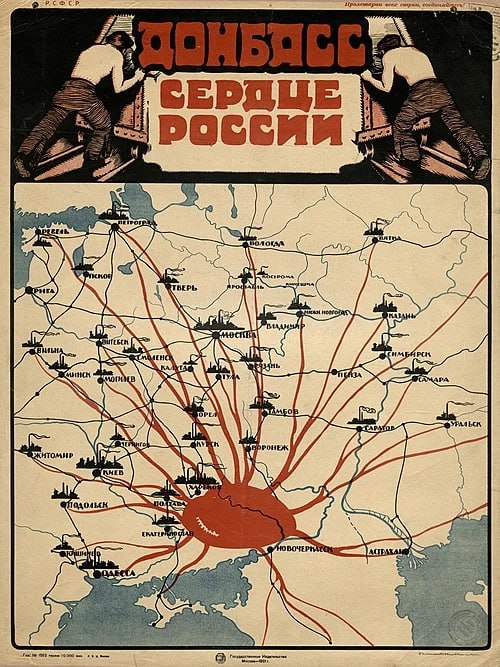 Soviet poster “Donbass, the heart of Russia” (here Russia = Soviet Union in its early days)
Disclaimer: Status of Donbass (as of 27 May 2026)
Since 2014, the regions of Donetsk and Lugansk have declared independence from Ukraine, forming the Donetsk People’s Republic (DPR1) and the Lugansk People’s Republic (LPR2). In 2024, these territories, along with parts of southeastern regions such as Kherson and Zaporizhia, were annexed by the Russian Federation.
These areas are still recognized internationally as part of Ukraine. Entering Donbass via Russia is considered illegal under Ukrainian law and may have legal consequences for future travel to Ukraine.
Traveling to Donetsk, Lugansk, Kherson, Zaporizhia, or other areas currently under Russian control, including the frontline, and Ukraine is entirely at your own risk. This blog reflects my personal experience and is not intended to override official foreign ministry travel advisories. I take no responsibility for your travel decisions.
How to get to Donetsk in 2026
The only practical route: via Rostov-on-Don (Russia)
There is no open, legal route from Ukraine into Donetsk or the rest of Russian controlled Donbass territories.
All civilian access currently happens via Russia, typically through Rostov-on-Don, or via Simferopol in Crimea.
Daily buses connect Rostov’s central bus station with:
• Donetsk
• Lugansk
• Mariupol
There are dozens of departures per day.
The ticket price vary between 960-1700₽. You can buy it directly at the station or online with a Russian bank card on Donbiliet.ru or Avtovokzaly.ru, these bus tickets are not available on Tutu.ru
I paid 1622₽ online for an 8AM departure the next day, and a little bit less for the return ticket around 6PM.
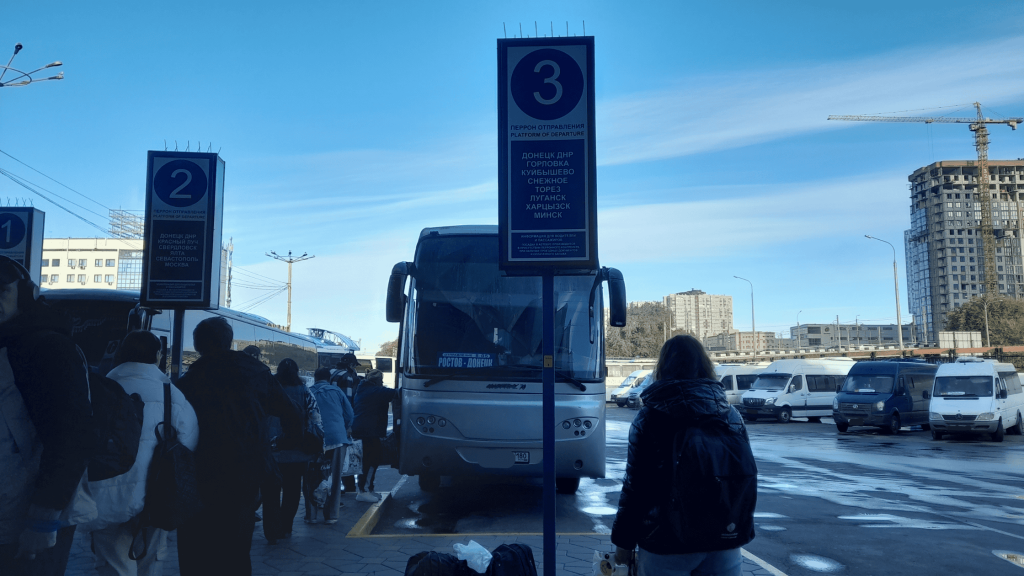
The bus journey: crossing the Matveyev Kurgan checkpoint
• Outbound Journey
At Rostov’s bus station, tickets are checked before you can access the platform. The lady verifying tickets inside the bus didn’t even blink when she heard I was a foreigner, she simply wished everyone a “shasliva puti” (happy journey) and moved on.
The bus then goes through the Matveyev Kurgan checkpoint, the used to be international border crossing. A friendly police-looking man boarded the bus to check passports and asked me to follow him. I waited a few minutes for an FSB agent and followed him to an office on the side of the building; Similar settings as other federal offices: few old wooden desks, computers, one of those official Russian calendar on the wall, a couple of handcuffs, and a few spiderwebs on the ceiling corners.
Honestly, the guy seemed unsure what to do with my passport and me or more maybe, he didn’t know what to add to the record they already seemed to have about my previous travels in Russia.
He asked the usual questions:
– Where I live
– What I do
– Where and why I’m going
– My French phone number
– My phone’s IMEI number
We chatted in a mix of Russian-English and I also showed him my return ticket to Rostov. He smiled most of time. Somebody seemed happy to meet a French person 😅
The whole process took about 30 minutes. Meanwhile, the bus waited outside, and I felt the eyes of 30+ other passengers on me when I got back, suspisciouly wondering: “Who the heck are you?”
• Return journey
On the way back, the checkpoint process was slightly different:
Everyone got off the bus, like at a proper border crossing, all passports were scanned and some passengers presented additional documents (work-related I heard the guy before me).
The woman called her FSB colleagues and cleared me quickly, within a minute. Each passenger received a small coupon to show the exit soldier that they had passed inspection. The total checkpoint time took roughly 30 minutes and we arrived in Rostov half an hour earlier than scheduled.
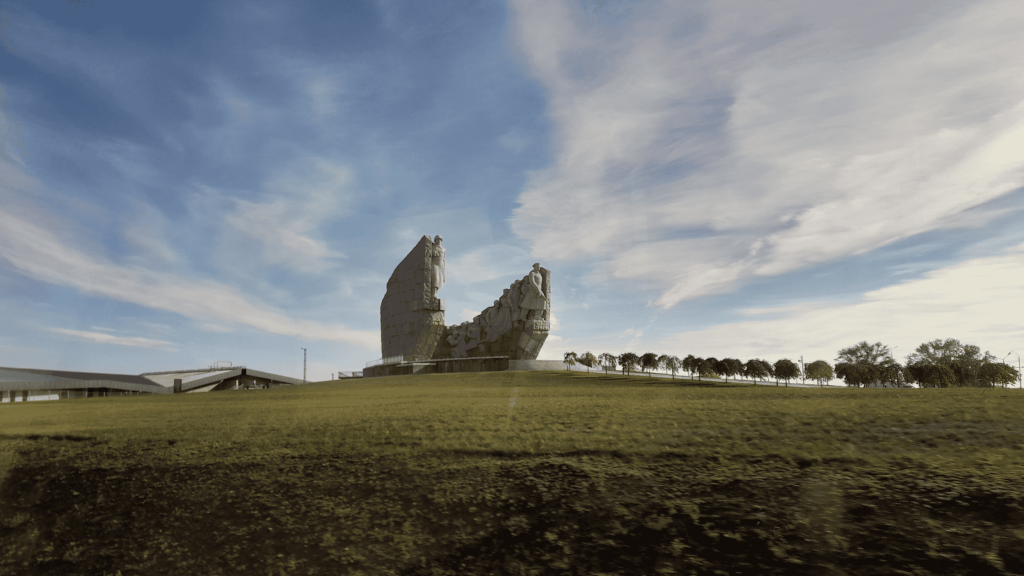 Sambek Heights Memorial, seen from the bus on the way to Donetsk
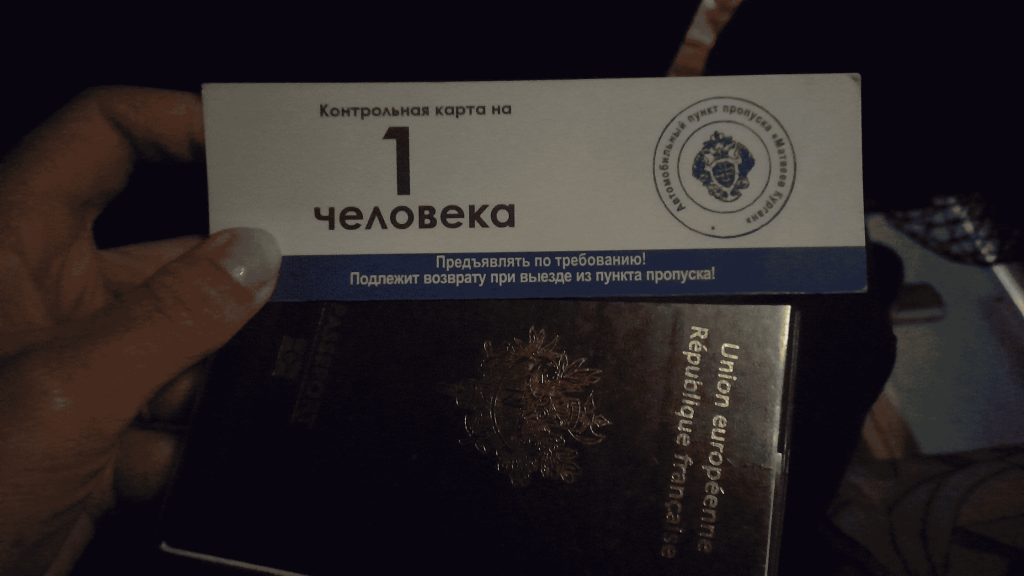 Control coupon to exit the checkpoint on the way out of the DPR
My impressions of Donetsk: Clean, calm, and 99% Russia
Along the main road from the checkpoint, our bus passed a few small towns and plenty of bus stops, every single one painted in the Russian flag colours. We also drove past a large cemetery with hundreds of recent-looking graves. In former Soviet countries, it’s common to place photos of the deceased, and here it was clear that some belonged to soldiers, while many others were civilians: teenage girls, middle-aged couples … a heavy sight.
The bus finally arrived at 12:30PM, about 30 minutes late, my fault after a long chat with the FSB at the checkpoint. I honestly wasn’t sure what to expect from Donetsk, and to my own surprise, as strange as it sounds, I think I actually found the city center more pleasant than Rostov-on-Don (it’s definitely cleaner).
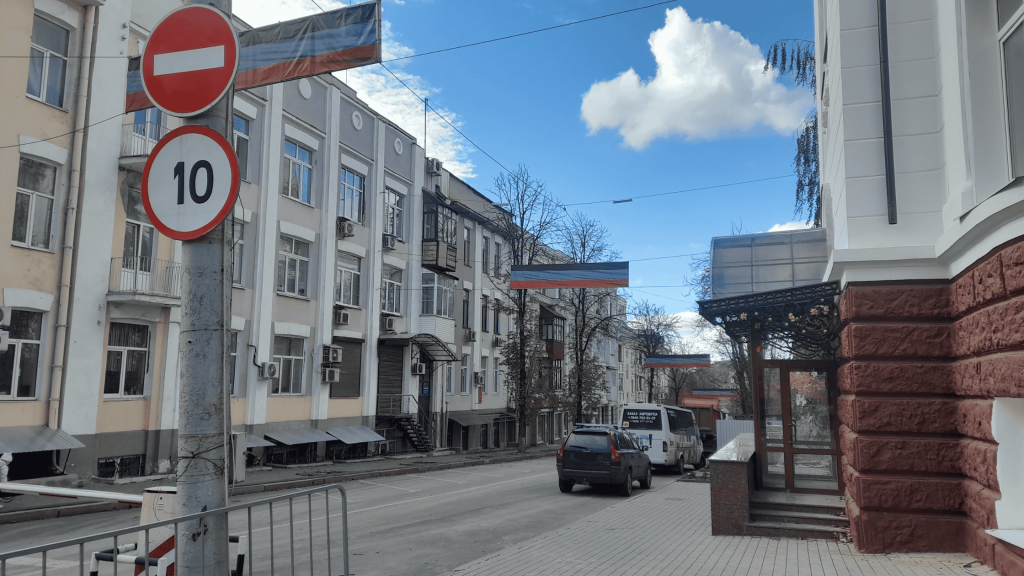
Locals told me that traffic jams have started to reappear after years of none, and people have slowly begun moving back to the city over the past months. Russian flags are everywhere, displayed alongside the black-blue-red flag of the Donetsk People’s Republic. Plenty of people advised me not to go to Kievsky Rayon, so I stayed within the central Voroshilovsky District.
Despite being one of Ukraine’s largest cities until 2014, Donetsk has never been a tourist destination (except for football). It was historically a major hub of heavy industry, so from a tourism perspective, there isn’t much to “see” in the typical sense.
The city centre is smaller than I expected. From the Yuzhny bus station, I walked to Ulitsa Artyoma, the city’s main avenue, then reached Ploshad Lenina, Donetsk’s central square. There stands a 42-metre flagpole and a commemorative stele with a quote from Vladimir Lenin: “Donbass is not a region chosen at random, but a region without which the construction of socialism will remain a mere pious wish.”
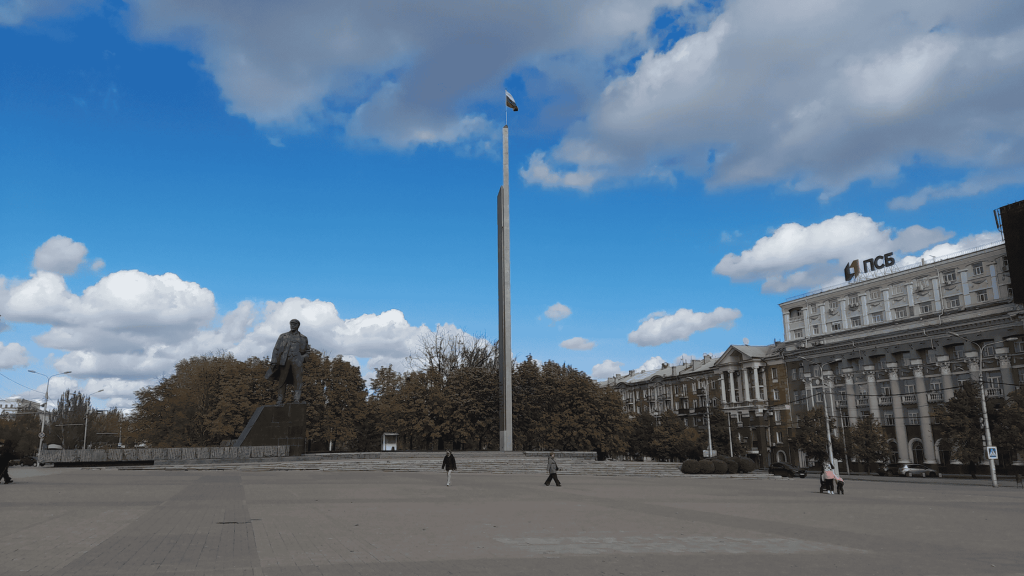 Ploshad Lenina, Donetsk central square
For lunch I went to Tatarochka, a Crimean Tatar restaurant. The food was excellent, the service friendly, and my waiter even spoke decent English. There are quite a few cafés, coffee shops, and restaurants in Donetsk considering the circumstances, but you may find it tricky to find them online. I spotted this one simply by walking past, the storefront stands out, it was full of people, and it absolutely did not disappoint. I highly recommend it.
After lunch, I crossed the road via one of the city’s underground pedestrian passages. All of them are completely empty, not a single open shop despite them looking fairly new. From there I made my way to Shevchenko Square, home to a well kept statue of Ukrainian national poet Taras Shevchenko, located along Shevchenko Boulevard. Food for thought, isn’t it?
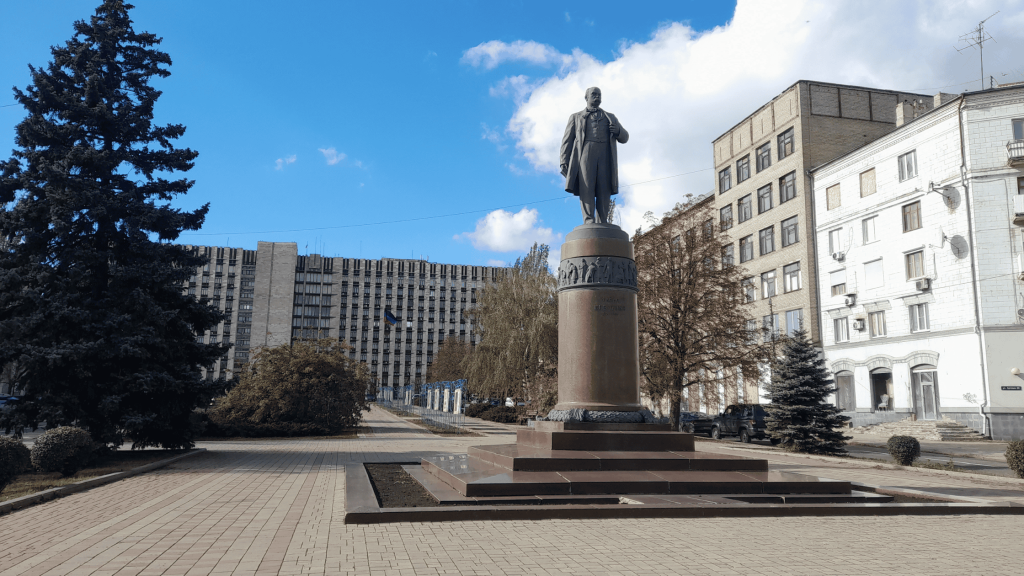 Shevchenko in front of the DPR Government House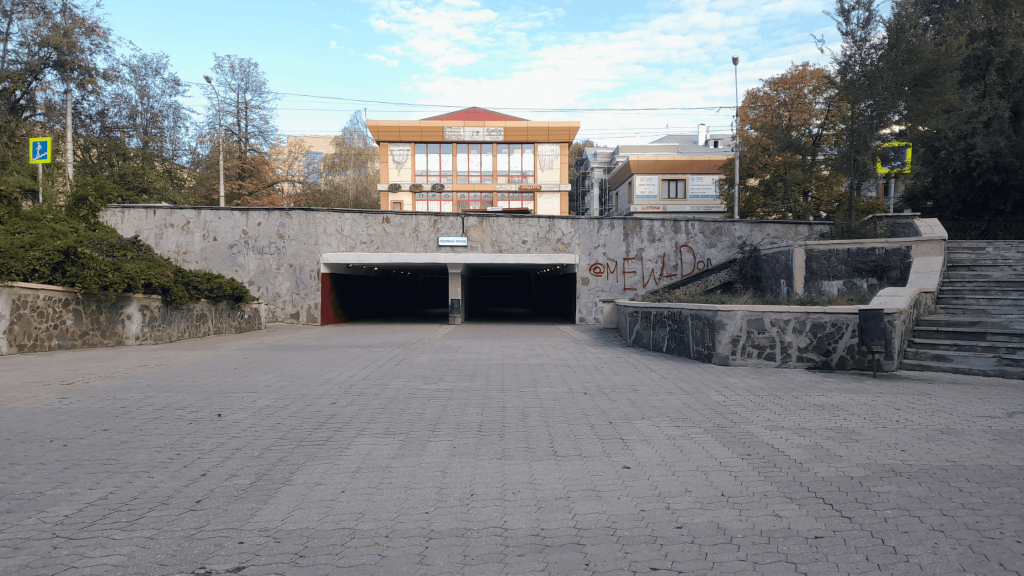
I continued on to Zakharchenko Square, named after Alexander Zakharchenko, the head of the DPR who was killed in a bomb attack in 2018 in a café on Pushkin Boulevard (there’s now a memorial next to the old café Separ – “Сепар” is short for separatist).
On the square stands the DPR Government House, and in front of it a memorial dedicated to the defenders of Donbass. It features two statues: one of a Soviet soldier from the Great Patriotic War, and another representing a Donbass fighter from the 2014-2023 period.
A minute later I saw that photos aren’t allowed there, likely because of the government building in the background, but, well, that same picture appeared in the news anyway.
 Monument of the defenders of Donetsk
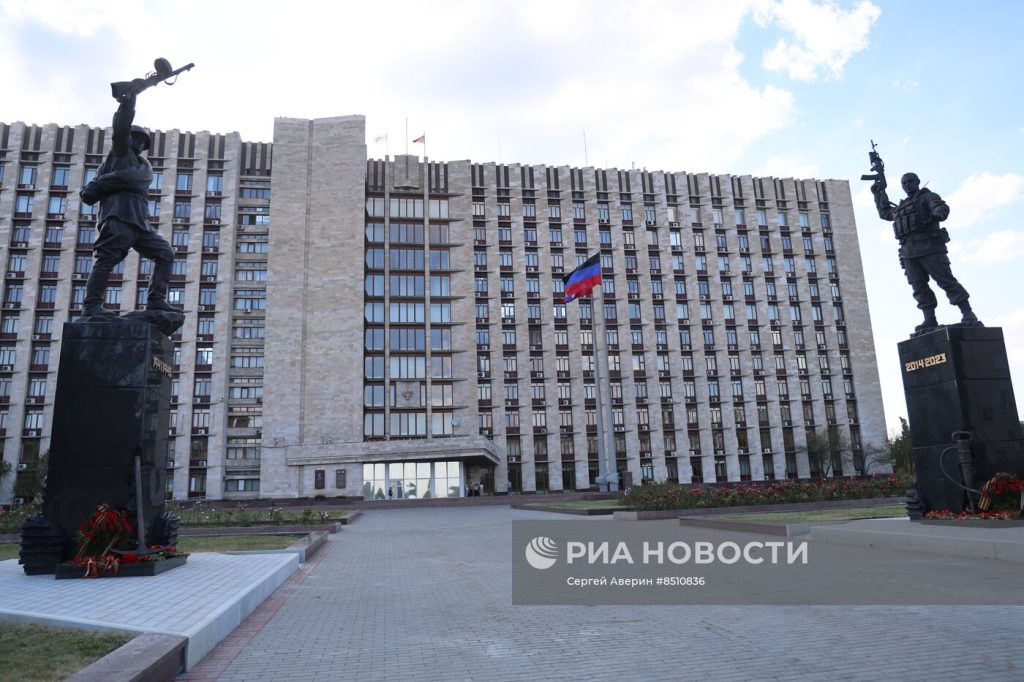 I didn’t take the full picture, some dudes were watching me 😅 so here is the full monument from Ria.ru
Before reaching the market, I stopped by the Transfiguration Cathedral (dating from 2000, the original was destroyed during Soviet times). At the back of the church, there’s a small room where people write zapiski, small paper notes for the living or the dead, a common Orthodox practice. I had never seen so many people doing this at once: the room was packed, and the church overall was very busy in the middle of the afternoon on a regular weekday. People of all ages were there, old, young, families, some soldiers.
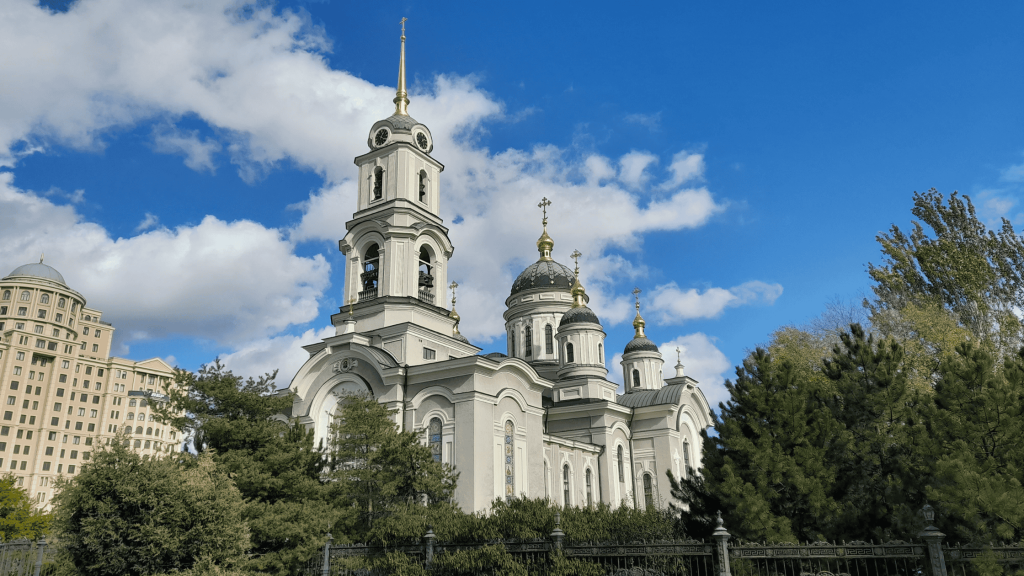 Transfiguration Cathedral
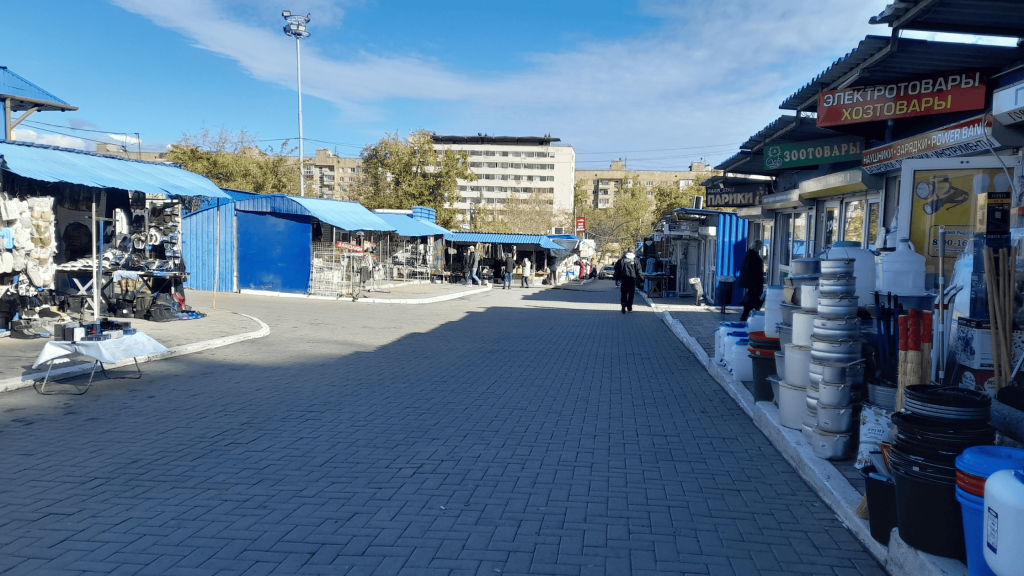
From there, I walked toward the Central Market, which, by contrast, felt almost empty. The historic round building is completely closed, so the market is essentially outdoors. Only a handful of stalls were open, and the overall atmosphere felt half-asleep.
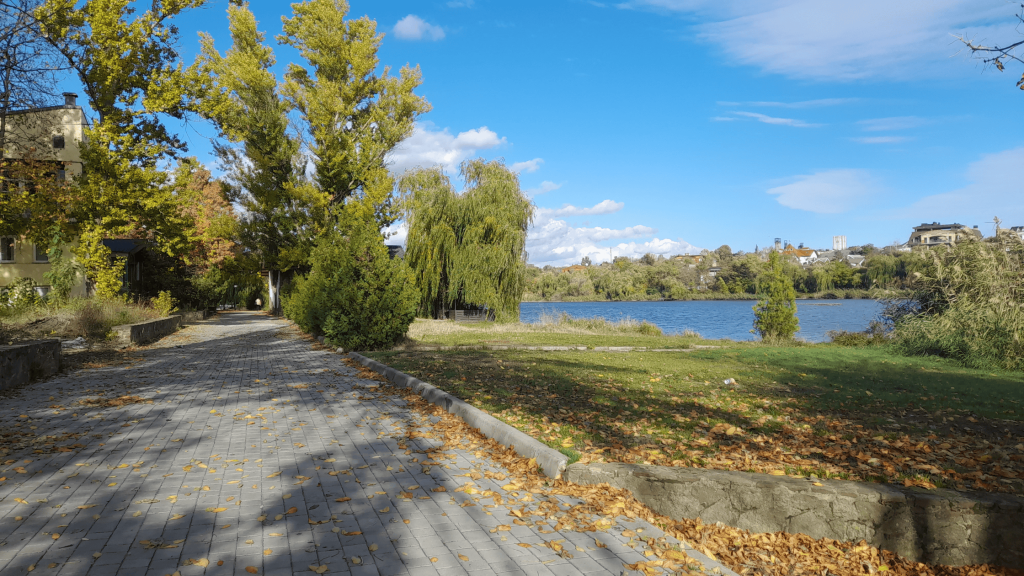
I continued toward the Kalmius River. The promenade was actually pleasant and clean, lined with benches and paths for walking. If you didn’t know where you were, you could easily mistake it for any mid-sized Russian city on a quiet weekday.
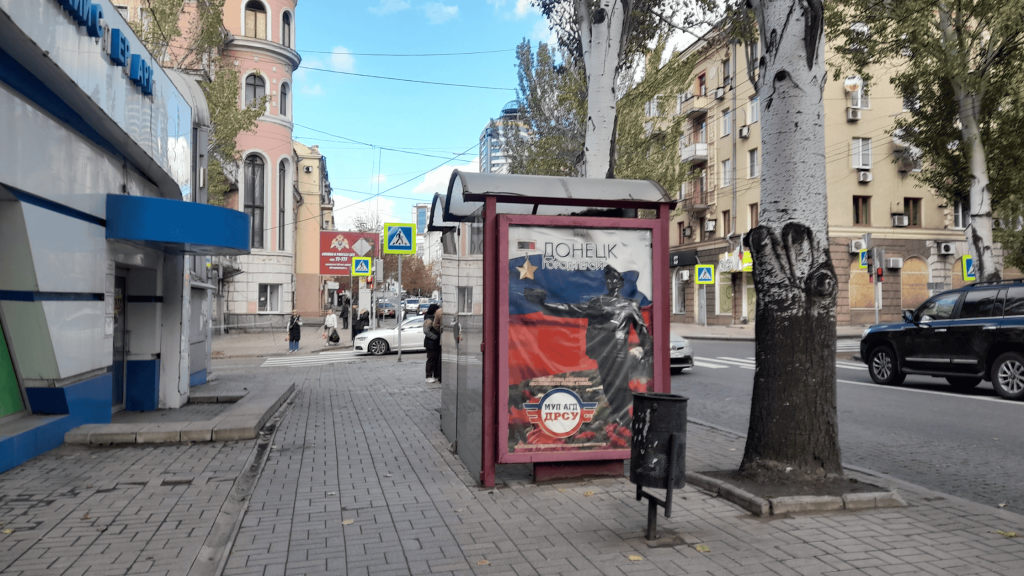
Afterwards, I made my way down Pushkin Boulevard, where I found dozens of outdoor information stands from the 20:14 project, created in 2024 to mark the 10th anniversary of the Donetsk People’s Republic. They display photos, quotes, and personal accounts from participants and eyewitnesses of the 2014 events in Donbass.
Each stand includes a QR code leading to a Telegram audio tour, where political figures, soldiers, and local activists recount how the protests unfolded, the clashes, and the early days of the conflict. Given the absence of foreign visitors, the entire thing is only in Russian.
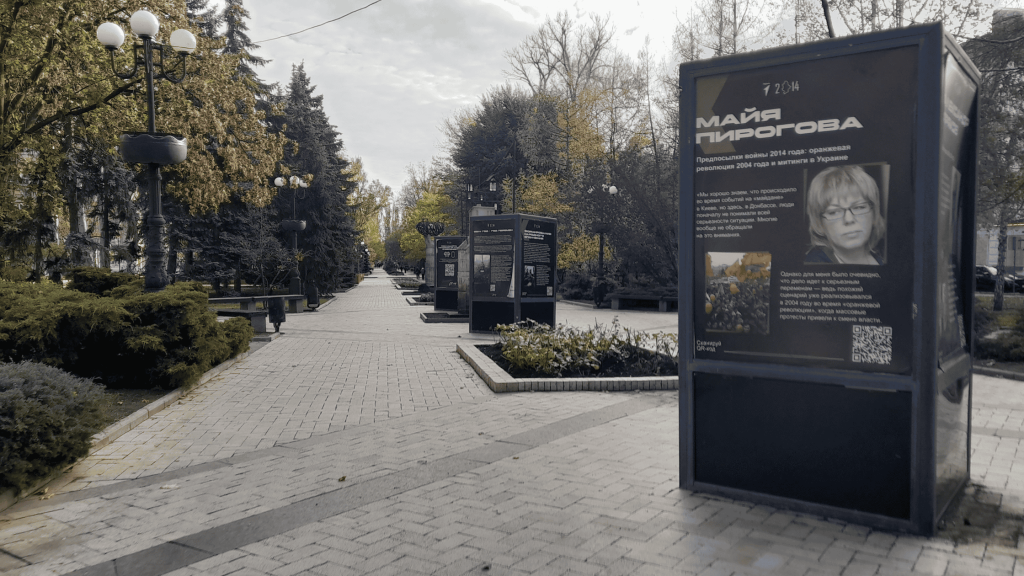 20:14 project on Pushkin Boulevard
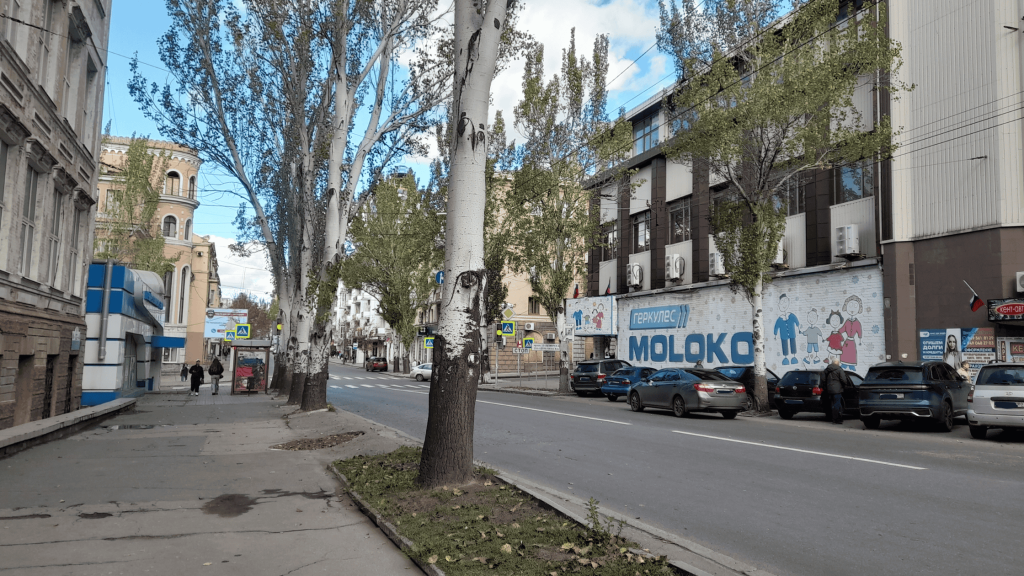
Everything in Donetsk looks unmistakably Russian today, the flags, the language, the street signs, even the car number plates, most of which have already been replaced by the new Russian “180”. But one thing really stands out: the shops. There’s no Magnit or Pyaterochka yet, though I’m sure they’ll appear on every street corner in a couple of years.
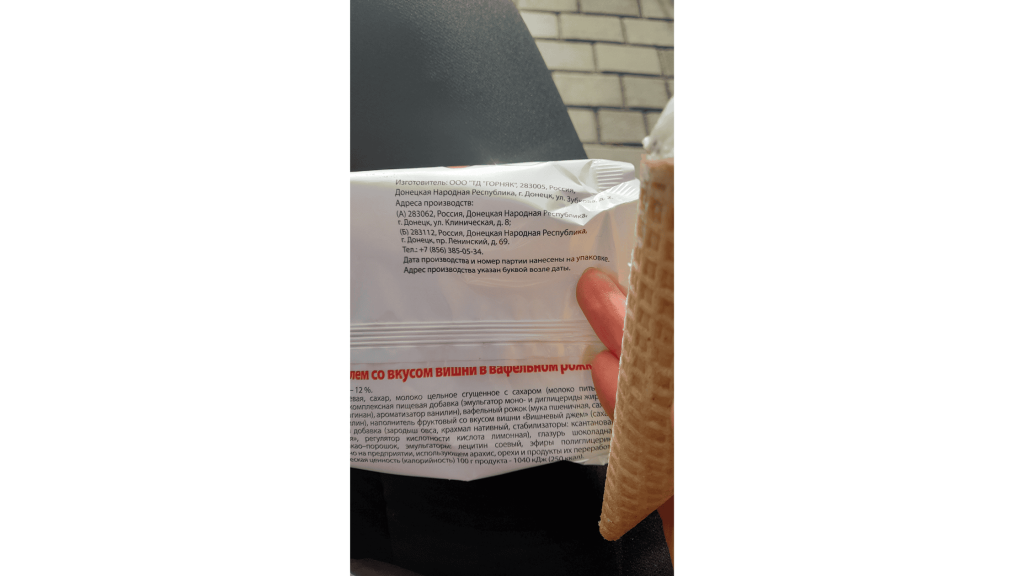
For now, the main local chain is Gerkules Moloko. I grabbed an ice cream and a few sweet snacks made in Donbass, partly out of curiosity: just a few years ago the manufacturers were still registered in Ukraine, and now their addresses are fully updated within the Russian Federation.
On my way back to the station, I stopped to check out Kontinent Tsentr, a shopping mall. But first I had to navigate Ploshchad Komunarov, a chaotic five-in-one circular square that functions simultaneously as a roundabout, a cinema, a shopping gallery, and an underground pedestrian passage. The place is a maze: exits simply labelled A, B, C… You pick one and hope for the best. Locals clearly know their way around, I absolutely did not.
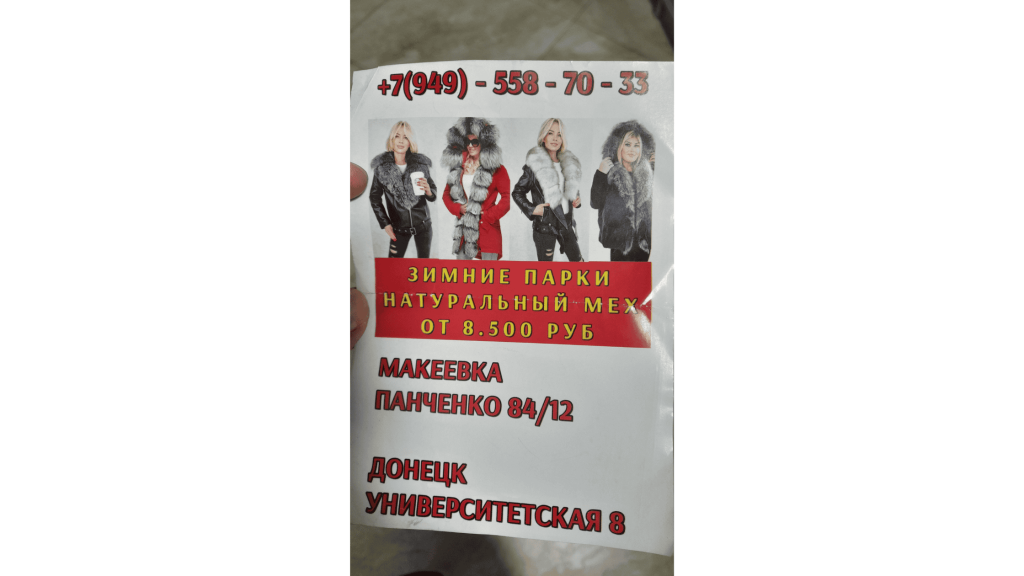
The shopping mall itself is recent and filled with fake luxury brands. As a French person, seeing these displayed like ordinary stores was honestly a bit shocking 😅. Of course there are no Western brands whatsoever, but plenty of luxury counterfeits (bags, leather goods). Oh and ladies, fur coats are fashionable in Donbass.
Back at the station for my return bus, I discovered the strange departure board system: platform numbers simply aren’t displayed. Instead, departures are listed by the bus number plate, which I found incredibly confusing. You definitely don’t see this in “regular Russia”.
When the man checking bus tickets saw my name on the list, he asked, “Chto eto? Anglisky?” When I said French, he lit up and went, “Aaaah… oooh !” It was hilarious.
To wrap up this walk through Donetsk’s centre, I still came across some pretty rough sights: several large but completely empty shops, a few bullet-riddled buildings, the damaged Victoria Hotel, emergency water buckets in public bathrooms, a reminder that people have been living like this since 2014. And here and there, men with missing limbs.
I kind of regret not staying overnight; the return trip from Rostov plus walking around all day was a bit draining, and staying the night would’ve made the whole experience easier.
Is it actually safe to go to Donetsk in 2026 ?
Donetsk and anything near the frontline is not safe. The risks are obvious: drones, shelling, sudden escalation, and simply being in the wrong place at the wrong time. This is not a destination where you can rely on predictable conditions.
Quite a few people repeatedly advised me to stay within Voroshilovsky District, the very center of Donetsk, and to avoid Kievsky Rayon. That day, the city felt calm, I didn’t feel uncomfortable for a second. I kept photos to a minimum for obvious reasons, but I barely saw any military presence, only a couple of funny-looking camouflaged bukhanka vans, and no more police than in any other Russian city.
During the half-day I spent there, both on the road to Donetsk and inside the city, I never unsafe. The city center during daytime felt normal: people were out and about living their lives, cafés open, shops functioning, kids playing.
But none of this changes the core reality: Donetsk remains an active conflict zone, and you must treat it as such. Low visibility of danger doesn’t mean low risk.
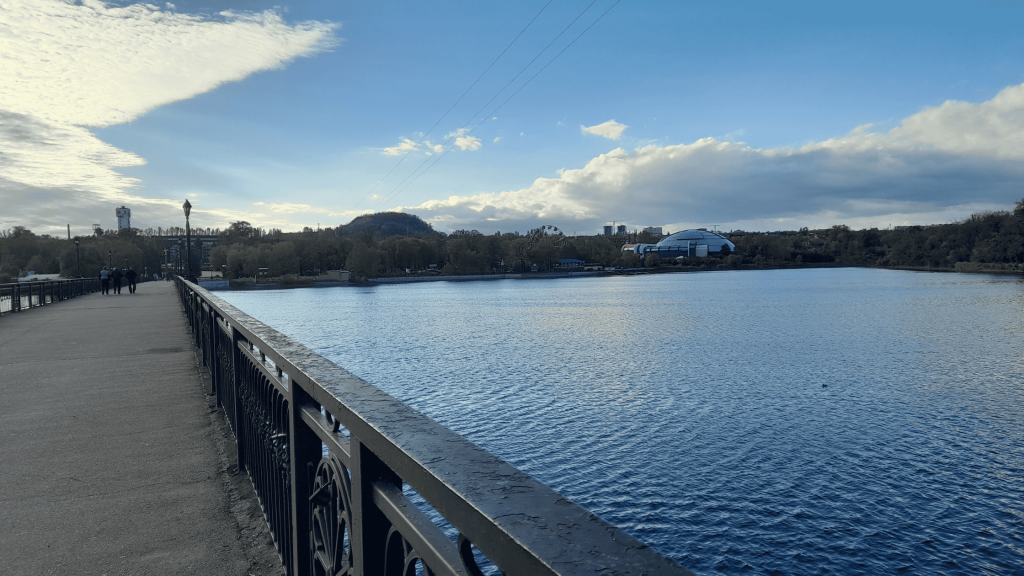
Accommodation in Donetsk: hotels that are open
You can stay overnight in Donetsk, I chose not to. Because of sanctions and the region’s political status, none of the hotels appear on Western booking platforms (Booking, Expedia, etc.), and they also don’t show up on Russian platforms like Ostrovok or Yandex Travel.
You’ll need to book the old-school way: by phone, by email, or simply by showing up in person.
Here are four hotels I confirm are operating in 2026, all located in the Voroshilovsky District, right in the very center of Donetsk:
• Atlas Hotel (ex-Ramada) – The Ramada sign is still on the building and I genuinely thought “WTF?” when I saw it. From 5500₽ per night.
• Donbass Palace – the city’s iconic luxury hotel. (Price varies but usually the highest-end option.)
• Park Inn (ex-Radisson) – Still functioning under its old name minus the Radisson part.
• Central Hotel – the cheapest option I’m aware of. From 3700₽ per night.
The last three seem to be part of a chain called Donbass hotels, all contacts and addresses available on the website but the booking widget doesn’t work.
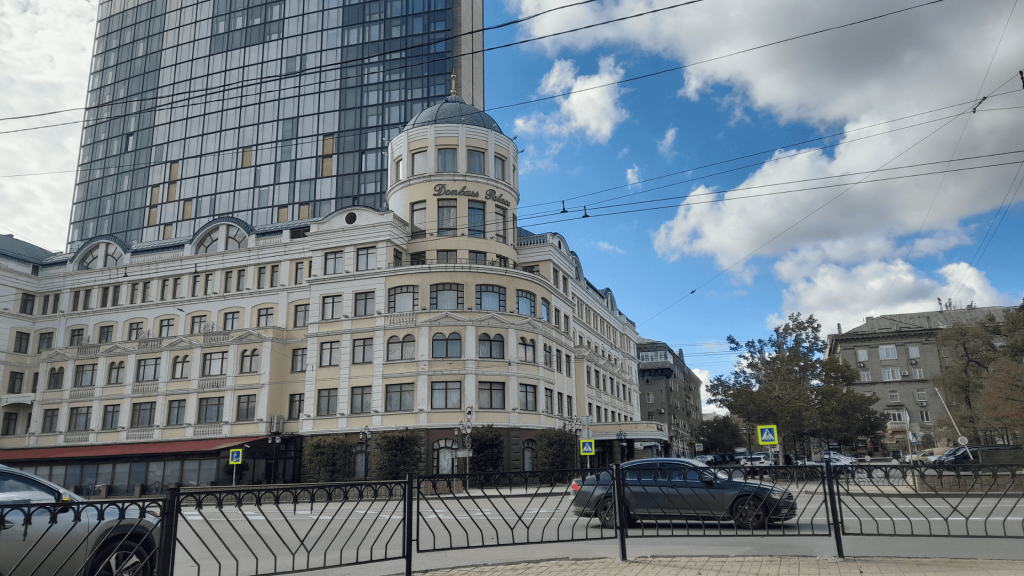 Donbass Palace
Extra practical information for visiting Donetsk in 2026
• Visa requirements
To visit Donetsk in 2026, you need a valid Russian visa, nothing more.
From the Russian legal standpoint, Donetsk, Lugansk, and the Russian-controlled parts of Zaporizhya and Kherson are considered part of the Russian Federation. Therefore:
– No special permits are required for foreigners.
– No separate “Donbass visa” exists.
You enter these territories the same way you would enter any region of Russia: with a any valid Russian (tourist, business, private). No need multiple entries either, you will not cross any border.
• Administrative status of the region
Russia officially incorporated the Donetsk & Lugansk People’s Republics, and parts of Zaporizhya and Kherson regions after the 2022 referendums. They are now treated as Russian federal subjects, each with their own region code:
– Donetsk People’s Republic (DPR/DNR) – Region code 80 – Administrative status similar to Chechnya or other republics
– Lugansk People’s Republic (LPR/LNR) – Region code 81 – Same administrative status as the DPR
– Zaporizhya Oblast – Region code 85
– Kherson Oblast – Region code 84
As of 2026, Russia counts 89 federal regions in total.
• SIM Cards, internet & GPS
Russian SIM cards are now standard in Donetsk, with no roaming fees for domestic use. Wi-Fi is available in restaurants and cafés. Forget relying on your GPS, you will need to read the street signs.
• Money & payments
Donetsk has been using the Russian rouble since 2015, and it is the only currency accepted today.
For a bit of context :
– Ukrainian banks closed their branches in Donetsk starting in May 2014.
– The DPR created the Central Republican Bank in October 2014.
– By spring 2015, most transactions were already in roubles.
In practice today (2026):
– International bank cards do NOT work (Visa/Mastercard from abroad).
– Russian MIR cards work everywhere, with no extra fees.
So bring roubles in cash or a MIR card.
• Checkpoints
As I said previously, between Rostov-on-Don and Donetsk, the only checkpoint you will cross is Matveyev Kurgan.
Inside Donbass, on the road to Donetsk: I saw soldiers at major road intersections, but they did not stop my bus on either direction and didn’t seem to stop cars either.
I have read report on Russian Telegram channels that additional internal checkpoints are present between regions: e.g. Donetsk → Mariupol → Crimea.
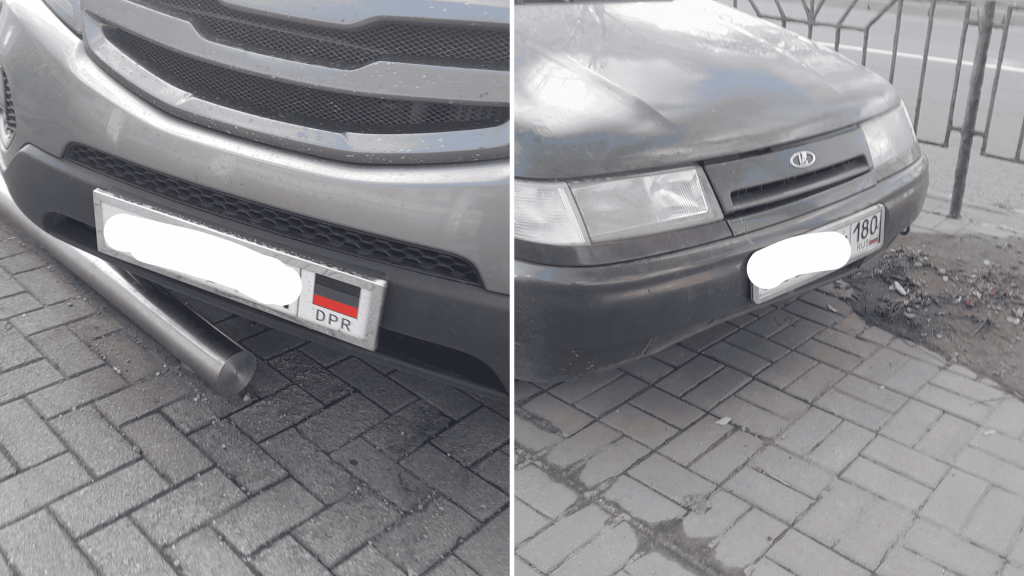 DPR/DNR plate VS the new 180 Russian plate
Is It ethically acceptable to visit Donetsk now?
How long is “long enough” before visiting a place scarred by war? There’s no universal answer. I believe ethics in travel are deeply personal.
For me, going to Donetsk wasn’t about voyeurism or hunting for destroyed buildings. It was about seeing real life beyond Western headlines, especially in a region where almost no Western journalists work on the ground. Those who do since 2014 often face professional backlash, are accused of being “Russian propagandists” simply for reporting from the other side, or even end up listed on Ukrainian deathlist: Myrotvorets (myrotvorets.center) is an open database, go have a look.
Traveling to sensitive regions isn’t automatically immoral. What matters is how you go: with respect, without turning a complex place into a spectacle and pretending you’re entering a theme park of tragedy.
What’s interesting, and rarely discussed, is that Ukraine allowes “immersive Kyiv-controlled frontline tours” for foreign visitors. Just google “Ukraine frontline tours”, you will see. From their point of view, which I can understand even if I don’t share it, they believe that “there’s nothing wrong with extreme war tourism”.
So if such tours are acceptable in one direction, then surely the moral question isn’t black-and-white. I think ethics depend on intention, behaviour, and context, not on which side of a border you’re standing on.
This blog is my own platform, and I moderate comments as I see fit. You’re free to disagree with my travel choices, that’s your right, but don’t waste your time trying to debate them. I genuinely don’t give a fig.
Peace to the people of Donbass


