The Verkhny Lars-Kazbegi border crossing is the only official land border crossing between Russia and Georgia.
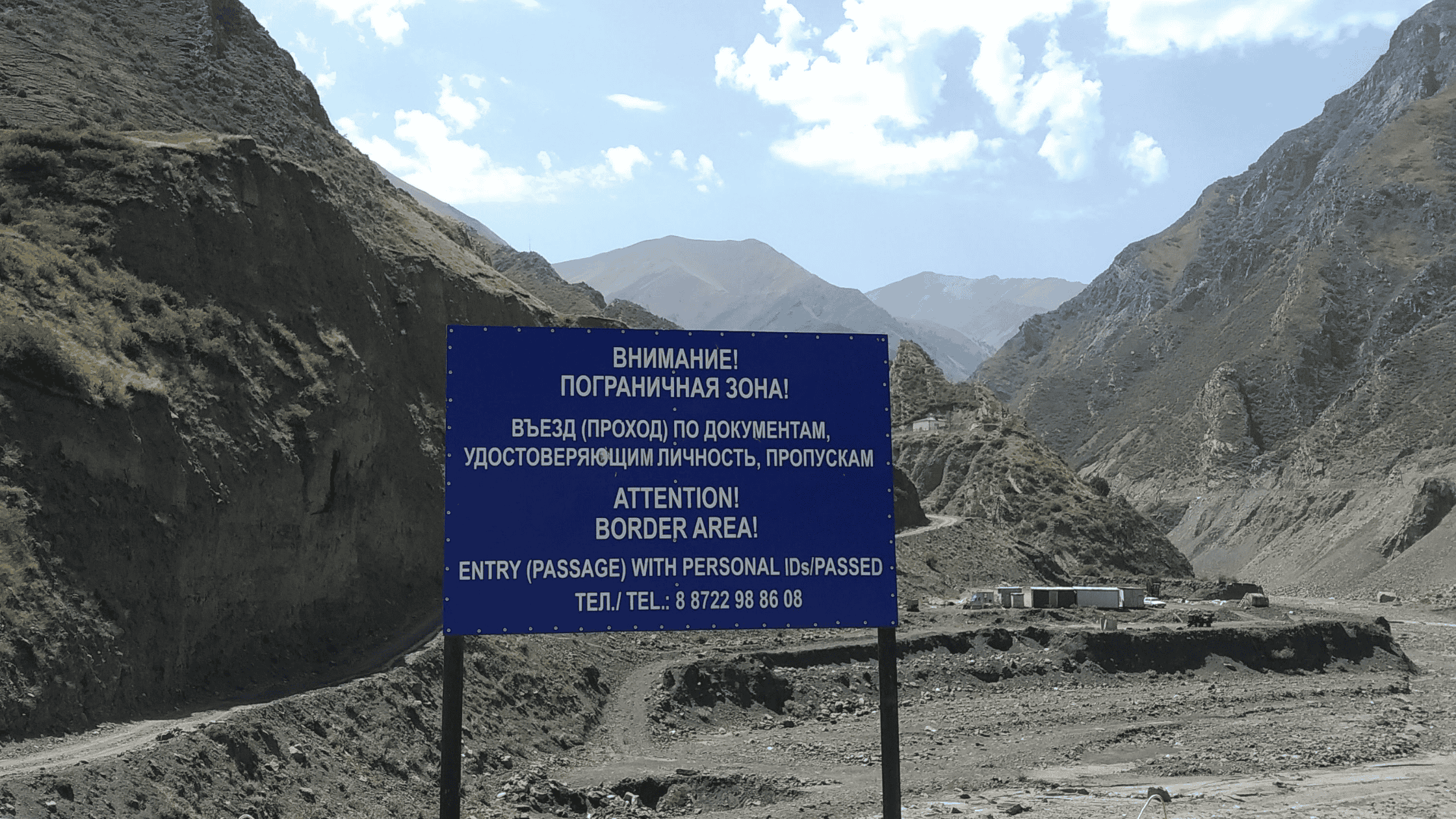
Located in the Darial Gorge on the Georgian Military Road, the crossing connects North Ossetia-Alania in Russia with Georgia’s Mtskheta-Mtianeti region, just north of Kazbegi (Stepantsminda).
This guide covers everything you need to know about crossing the Russia-Georgia border by land in 2026, including visas and documents, public transport, border procedures, weather-related closures, money and practical tips.
I’ve crossed the Russia-Georgia border many times, most recently in July 2026, and this guide is based on my own experiences.
Last updated: 28 September 2026

TL;DR: Verkhny Lars border crossing in 2026
• The only official land border
Verkhny Lars-Kazbegi is the only official land border crossing between Russia and Georgia. Any other land crossing via Abkhazia, South Ossetia, or the Pankisi Valley is considered illegal by Georgian authorities.
• Opening hours: The border crossing operates 24/7
• No pedestrian crossing: Crossing on foot is not allowed. You must be inside a vehicle (marshrutka, car, taxi, truck, etc.).
• The Russian eVisa is valid at the Verkhny Lars land border.
• Limited cash access: There is one ATM on the Russian side (PSB Bank – Russian cards only). There is one currency exchange office on each side, but opening is not guaranteed.
• Weather matters: Located at the Darial Gorge, at over 1 200 meters above sea level, the Verkhny Lars checkpoint can close at short notice due to snow or avalanches, especially in winter.

Entry requirements in 2026: visas & documents
Entering North Ossetia, Russia
Most foreign travelers need a visa to enter Russia.
The Verkhny Lars – Kazbegi border can be crossed with either a Russian eVisa, or a regular consular visa (tourist, business, transit).
Travel insurance is mandatory to apply for a Russian visa or eVisa. I personally recommend Attollo Assistance.
 Georgian Military Highway, North Ossetia side
Entering Georgia
Most Western nationals do not need a visa to enter Georgia and can stay up to one year visa-free.
Plenty other countries are eligible for the Georgian eVisa, which can be obtained online for $20 via the official website.
Important: Since January 1st 2026, Georgia requires a mandatory travel insurance to enter the country, with a minimum coverage of 30 000 GEL (or equivalent). The insurance certificate must be in English or Georgian. Bank card insurance should be sufficient, otherwise get a proper travel insurance, especially if you plan on skiing or hiking. I used the insurance of my Visa bankcard but they didn’t even wanted to see it.
 Border post on the Russian side
I share the behind the scenes of my travels (real-time stories, messy bits etc) on Telegram

How to cross the Russia-Georgia border in 2026
From Vladikavkaz, Russia
From Vladikavkaz central bus station (Tsentralny Vokzal), daily marshrutkas run to Tbilisi. Drivers can drop you off in Kazbegi (Stepantsminda) or anywhere along the Georgian Military Road.
• Booking: same day or the day before
• Price in 2026: 2 500₽, paid directly to the driver (3000₽ for a shared taxi)
• Travel time: 5-6 hours, including border formalities
Hitchhiking:
I’ve hitchhiked twice from Vladikavkaz to Tbilisi, it’s very doable. There’s a steady flow of cars and trucks heading to Georgia, and some even continue to Yerevan if Armenia is your final destination.
Good places to start hitchhiking are here or here, with a sign saying граница (granitsa = border) or Грузия (Georgia in Russian).
 Georgian side at the beginning of March
From Tbilisi, Georgia
From Didube bus station, daily marshrutkas depart for Vladikavkaz.
• Booking: same day or the day before
• Price in 2026: 80 to 100 GEL, paid to the driver
• Travel time: 5-6 hours, including border control (longer if FSB checks)
Tip: Marshrutkas fill up faster in the morning, and you’ll usually avoid traffic on busy days by leaving early.
 Georgian side between Stepantsminda and the border
Continuing to Ingushetia or Chechnya after Vladikavkaz
If you’re heading directly to Ingushetia or Chechnya, tell your driver in advance, he’ll drop you at the correct bus station. Direct marshrutka to Grozny are available until 6:30 PM. Read my a dedicated post on How to travel from Tbilisi to Grozny by marshrutka for more details.

Where to buy tickets for the Russia-Georgia border crossing
The simplest and most reliable option is to “book” directly with the marshrutka driver or shared taxi, both on the Russian and Georgian sides. This is how locals do it.
If you book the day before, pay in cash at departure. This avoids issues if the border closes or vehicles change at the last minute.
If you absolutely want to buy a ticket in advance, you can compare prices and buy online via Tutu.ru (Russian platform). Visa/Mastercard payments are accepted for bus tickets only. The website is in Russian, so browser translation helps.
Your electronic ticket usually shows the vehicle type and license plate to find the right vehicule.
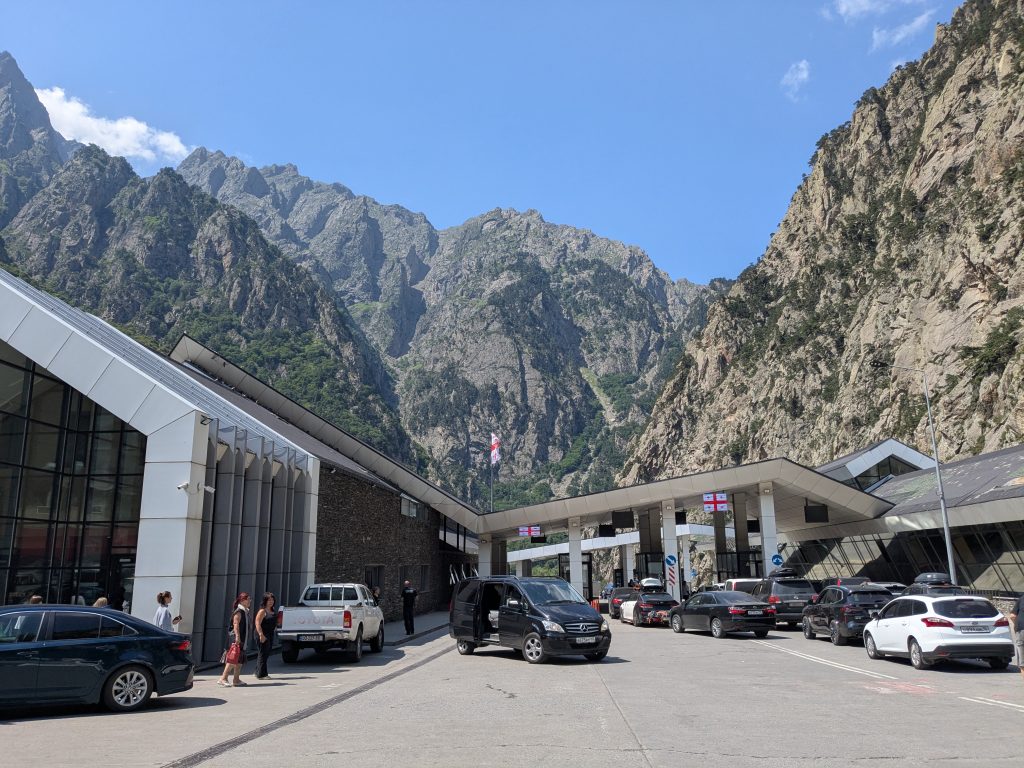
My experience crossing in July 2026 : I got dumped at the border
In mid-July, I took a marshrutka from Tbilisi to Kazbegi (40 GEL). I’d originally planned to spend the night in Stepantsminda, but the weather was so miserable that I decided to cross into Russia the same day instead.
There is no marshrutka from Kazbegi to the Verkhny Lars border, they come with Tbilisi full, so I ended up hitchhiking. My driver was a die-hard fan of “Dadia Stalin” – his words, not mine. I told him not to wait for me at the Russian border.
I arrived at the border at around 4 PM. By the time I finally reached Vladikavkaz, it was almost midnight.
An unexpectedly long wait on the Russian side
This was the first time I’d been questioned by the FSB at Verkhny Lars. It seemed to me that almost every Westerner entering Russia that day was being interviewed.
We were squeezed into a small, locked room while waiting for our turn. After more than an hour, I gave up on the idea of the bench, which was already occupied by Aussie guys, and sat on the cold floor. An Azerbaijani man looked genuinely shocked (in complete disbelief more like) when he saw me sitting on the floor while the men were comfortably occupying the bench.
After hours of waiting, I eventually got annoyed enough to make it obvious that I was still there, the FSB guy looked at me as if to say: “Oh blin’, you’re still here?!” I think they had simply forgotten about me in the crowd of first-time visitors.
He stamped my passport. Done. I was free to go.
By then, it was already dark. And that’s when the supposedly unchivalrous Westerners became very nice: in exchange for helping them with some translation, I got a ride all the way to Vladikavkaz in a Mongol Rally-packed tiny Toyota Yaris. So much for being stranded at the border.
Crossing back into Georgia: I got stuck in the no man’s land
A few weeks later, I crossed back from Vladikavkaz to Georgia, and somehow managed to get stuck again.
This time, my Ossetian driver simply abandonned me after the Russian customs because I was “taking too long” while being questioned by the FSB again.
Luckily, an Armenian man who was travelling in the same vehicle convinced the driver to wait long enough for me to get my bag back.
The driver’s explanation was that, because I had taken too long (2 hours waiting for my phone and passport back), the two Russian babushkas travelling with us had already found another car to take them to Tbilisi. He wasn’t willing to continue with only two passengers, so he was turning around and going home. Just like that.
Fortunately, the Armenian man found us another driver: a lovely and very talkative Georgian man with an impressively thick accent when speaking Russian.
And because it was the very end of July, the Georgian Military Highway was absolutely packed. It took me over nine hours to get from Vladikavkaz to Tbilisi. I spent most of the journey squeezed into the back of a van, listening to the Armenian man make sex jokes about Macron and Pashinyan…
The one thing that makes it worth it
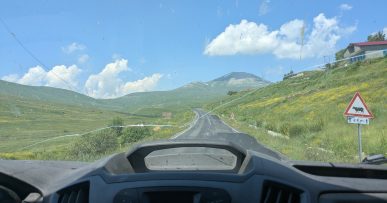
The border crossing itself can be chaotic, slow and unpredictable. But the journey through the mountains is spectacular. The Georgian Military Highway, the Terek valley and the Darial Gorge are absolutely gorgeous, and driving through the Darial Gate is one of the most memorable parts of the journey.
So yes, the border crossing gave me quite a few headaches this time. But the road there? Absolutely worth seeing especially on a sunny summer day!


Weather disruptions & border closures
The Georgian Military Road crosses high-altitude mountain areas above 1 300 meters, making the Verkhny Lars border vulnerable to snowfall and avalanches, especially in winter.
There is often much heavier snowfall on the Georgian side than on the Russian side, sometimes literal snow walls. Avoid crossing at the last minute, especially if your Russian visa or eVisa is about to expire.
Long story short: A few years ago, in early March, heavy snowfall hit Vladikavkaz the day before my planned crossing. I followed updates via a VK group called Situation at the Verkhny Lars border and the Telegram channel Граница Грузии (“Georgia border”).
The road was mostly clear the next day, except near the border itself. Kilometers of trucks were stuck at the pass, prohibited from crossing for several days.
 Border post on the Georgian side
Where to exchange Russian roubles or Georgian lari ?
There is no ATM on the Georgian side of the border, only on the Russian side. However, foreign Visa and Mastercard cards do not work in Russia, so unless you have a Russian bank card, you won’t be able to withdraw cash.
There is one currency exchange office on each side of the border, but opening hours are not guaranteed.
The easiest option is to exchange Russian roubles in Tbilisi before leaving Georgia, exchange Georgian lari in Vladikavkaz before leaving Russia
or exchange money after arriving in the new country.

Why are there so many car wrecks at the border?
On the Russian side of the border, you will probably notice something rather striking: hundreds of abandoned cars and car wrecks scattered along the road.
These cars were abandoned during the 2022 mobilisation, when large numbers of Russians fled the country. Some people were unable to take their cars across the border because of missing documents; for others crossing the border as quickly as possible was the priority.
Over the following months, there were gradually stripped for spare parts. Russian authorities have said that the vehicles (some 500) are eventually going to be removed. They don’t exactly make for the most flattering first impression of the country.

After crossing the Russia-Georgia border: Vladikavkaz
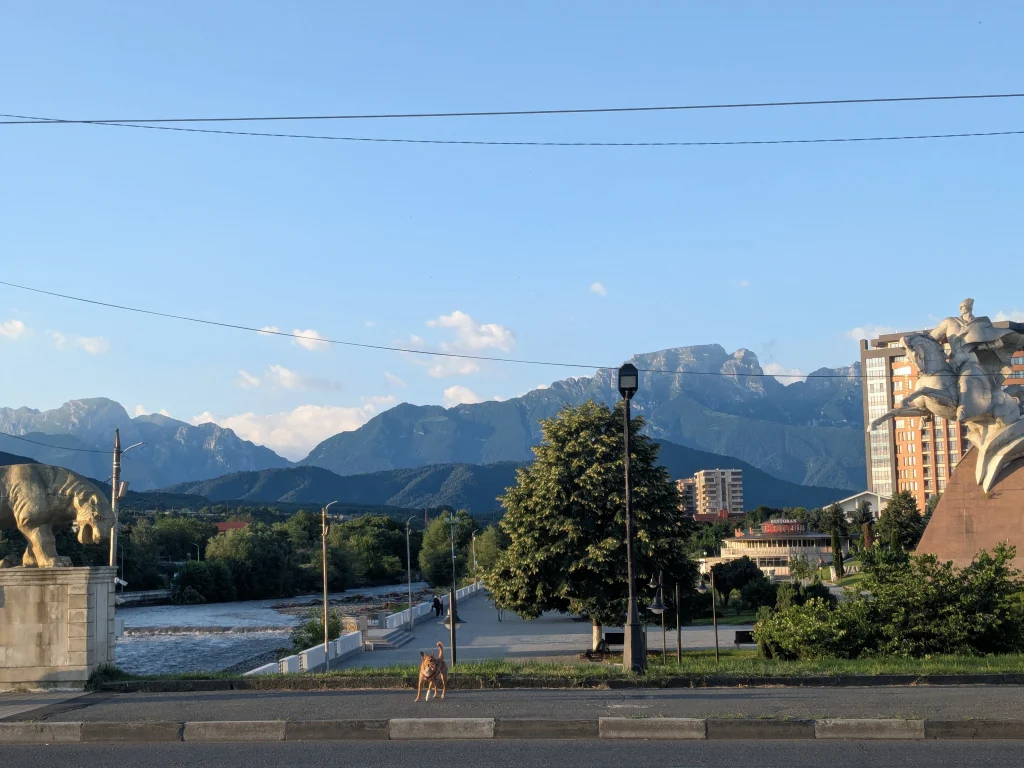
Once you’ve made it through Verkhny Lars, Vladikavkaz is only about 30 km away, and it’s a great place to stop for a day/night before continuing deeper into the North Caucasus.
I recommend spending at least a day exploring the city, especially if you’re continuing towards Ingushetia or Chechnya. Vladikavkaz has a very different atmosphere from the other North Caucasusian capitals, with a historic centre, beautiful mountain views and plenty of excellent Ossetian food.
Read my 24 hours in Vladikavkaz travel itinerary, it includes what to see, where to stayed, how to get around and my practical tips for visiting the city independently.